
Untitled Oil Painting by JMW Turner - Suggested subject: Châtelard Castle, Valle d'Aosta
Untitled Oil Painting by JMW Turner - Suggested subject: Châtelard Castle, Valle d'Aosta
The original published paper is available from JSTOR: British Art Journal Volume XXIII No. 3
Identifying the Location of a Sketch by JMW Turner and Re-titling an Early Oil Painting.
In 1802, the ratification of the Treaty of Amiens allowed artists an all-too-brief chance to travel freely across Continental Europe and, as has been documented by many scholars, the 27-year-old JMW Turner and a colleague, Newby Lowson, successfully completed an outstandingly ambitious tour that included part of the Alps. This paper identifies for the first time a sketch that leads us strongly to recommend a new title for a well-known Turner oil painting that in recent years has been widely exhibited in London, Switzerland and Germany.
During August 1802, Turner and Lowson made the exceptionally arduous trek around the western side of Mont Blanc from Chamonix to Courmayeur. We often suggest to those wishing to understand Turner better that they should hike this same route, as its difficult nature provides an insight into the character of the man, especially as he subsequently did it again at the age of sixty-one. This paper is part of a larger study we have made both of this trek into the Aosta Valley and of the one over the Grand Saint Bernard Pass as the two travellers exited this valley. We now have a good understanding both of their precise route around Mont Blanc and of the excellent weather.
In walking this several times ourselves, we have been able to reveal for the first time that Turner made several large and detailed sketches that later became damaged and almost unreadable. We have carefully drawn over what remains of his lines and thereby been able to find his viewpoints and plot his route. Our paper will be published in the new on-line version of The British Art Journal to be launched later in 2025.
On completing their hike around Mount Blanc, sketches indicate a likely overnight stay either in Courmayeur or in the small town of Pré St-Didier which lies at the bottom of an important Alpine crossing that would have been an easier but much less visually impressive way of crossing the Alps: the Petit St-Bernard Pass. The next day they probably set out on foot, although they could have hired wheeled transport or horses or taken the services of a muleteer. They made their way eastwards along the Aosta Valley that contains the Dora Baltea river, with Turner as usual sketching views that caught his attention. From Pré St-Didier, they were following a route first made passable to wheeled traffic by the Romans: the Via delle Gallie, or Voie des Gaules, linking Lyon and Milan via the Petit St-Bernard, Aosta and Ivrea. After 4 km alongside the main Dora Baltea river, they were in a small town called Morgex.
A very indistinct sketch from Turner’s Grenoble Sketchbook, TB-LXXIV-70 D04563 not shown here, drawn near Morgex, looks eastwards into the early morning sun and includes the distant peak of La Grivola that is almost 4000m above sea level, as well as a nearby ruin, Château Châtelard, that Napoleon’s troops had almost completely destroyed only nine years earlier, leaving a tower with its top section knocked off, surrounded by heavily-damaged walls and a lot of rubble. The next town of La Salle is only a further 4km, but now up a steady climb along a section called the Via dei Romani. It is likely that Turner would have observed the background to the castle constantly changing, and his party would have been pleased to arrive at the top of the climb and take a short break, before completing the remaining 600m or so to reach La Salle. Turner turned around to view where they had come from and was sufficiently struck by the magnificent view lit by strong morning light that he recorded in detail a sketch (Pl 1) that has apparently remained unidentified until now, probably because the graphite has become so very faint. We have considerably ‘enhanced’ this sketch to allow an appreciation of this impressive vista, but in the process, we have lost the delicacy of the original pencil lines.
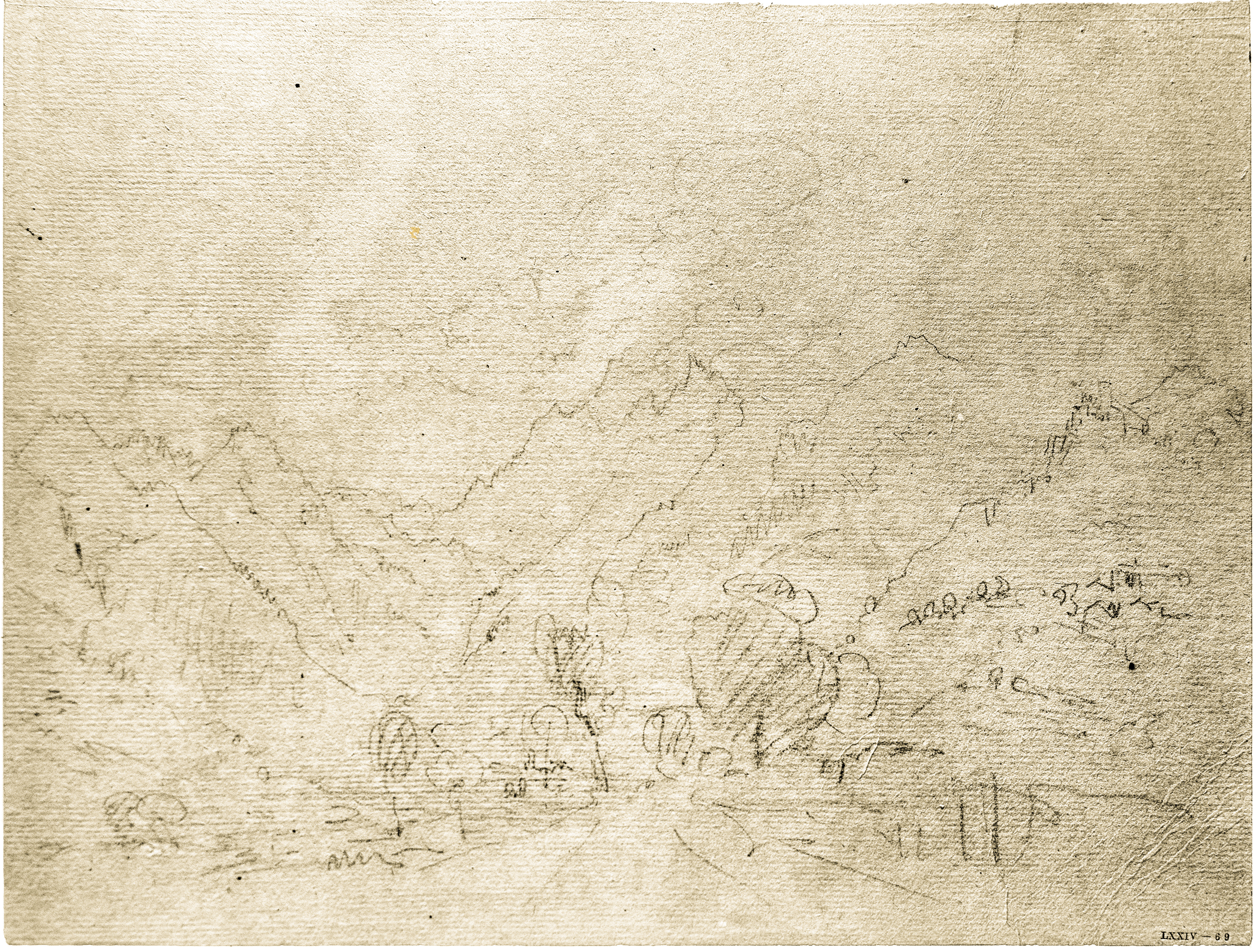
1 Official Tate Title: ?The Val d’Aosta near Courmayeur by JMW Turner (1775–1852), 1802. Page 69 of Turner's Grenoble Sketchbook LXXIV 69, Tate Ref D04562, pencil on paper 21.8 x 28.3 cm.
Identified here as a view looking west up the Valle d’Aosta but down the slope of the old Roman Road, with Château de Châtelard on the right, and Mont Blanc in the distance with it's peak in cloud.
Image: Lumby Tate Britain ref 20111116-A8487 Public Domain
In making a quick inspection of this drawing, we see immediately that the view looks directly along a straight road that takes our eye into a background that is entirely mountainous, although the most distant and highest peaks are in cloud. As we look more carefully to where the road seems to disappear from view, we notice, slightly to the left, a squiggly line that is typical of Turner’s shorthand for a distant conglomeration of buildings. On both sides of the road there are trees of various sizes and shapes. As part of a middle-distance mountain on the left we spot faint vertical lines. Turner invariably marks steep rock-faces like this. On the right we see buildings on a slope that is not far away, and at the top of this rising ground is a rather faint tower of a castle whose walls are also indicated. Behind the castle are the peaks of middle-distance mountains, and the lack of a continuous line suggests that there is some cloud here too. In the far distance there is a lot of cloud in the sky, and some mountains with very sharp peaks.

2 Present-day view looking west, up the Aosta Valley from Turner’s precise location in Plate 1, at the top of the climb from Morgex (in the middle distance) about 600m before arriving at La Salle, with the rounded peak of Mt Blanc in the distance. The Château de Châtelard is on the right. Courmayeur is not in the view; it is near the foot of Mont Blanc.
Image © Lumby 20220228- 36062-to-6
The view of this location today (Pl 2), taken in February 2022, is from precisely Turner’s viewing-point on the top of the hill on the old Roman road, while the season ensured that the tree on the right of the road did not obscure significant background. This view is sufficiently eye-catching on a cloudless day to result in many on-line photos from the nearby La Salle that inevitably focus on the main feature, Mont Blanc, even though it is distant. Interestingly though, the complete view sketched by Turner, in the form of a night-time photo, is of such local importance as to be the signature image on the official La Salle web site.
On the left of our photo is a wooden cross. In Turner’s sketch, there seems to be some structure in about the same place that we cannot quite make out. We have asked the administrators of La Salle for details about this religious site, and if it was there in 1802, and we await their response. The wall on the right results mainly from the levelling of the terrain behind it for agricultural reasons. The natural slope would be the continuation of that behind the cross.
As we see in so many of Turner’s landscapes, his sketch records how we later recall the view, whereas the camera, in needing to include the objects on extreme left and right, reduces the impact of the central items. Turner probably instinctively brings forward important distant objects that in our printed view from the camera have become insignificantly small. However, we have found that by projecting the camera’s image onto a large home-cinema screen, our appreciation becomes much closer to actually being there. And so, in order to make our comparison with the sketch easier to appreciate here in print, we split the view into three parts.
In Plate 3 we see the mountains on the left of Turner’s sketch, viewed from the road approaching the castle from La Salle. This slightly different viewpoint allows us fully to appreciate the remarkable accuracy of his quickly-drawn sketch, most easily appreciated by comparing the line of the mountaintops, their overlaps, and the folds in their slopes. Many sharp jig-jag lines that one might have thought were ‘artistic’ are remarkably close to those sharp peaks in, for instance, the top left of the photograph. Note also how those Turner short-hand up-and-down squiggles really do represent near-vertical cliff faces, our photo being taken with the sun in the south providing a raking illumination that makes these rocky textures especially clear.

3 View of the mountains on the left of Turner’s sketch that are on the opposite side of the Aosta Valley, photographed from a higher location near the castle.
Image © Lumby 20130712-2290
Our Plate 4 here is an image covering the central area of Turner’s sketch, cropped from Plate 2, that includes Mont Blanc on a clear day. We are fortunate that we authors live with a similar view from the northern side of Mont Blanc, and we are well aware that the mountain is more often than not obscured by cloud. A careful comparison of the rugged peaks in Plates 1 and 4 reveals that about the top 1000m of the mountain is hidden from Turner by cloud. For instance, we see Turner sketching the jagged needles left-to-right in front of Mont Blanc, the last one visible in moving upwards towards the base of the cloud being probably the Aiguille Noire de Peuterey at 3772m, whereas the top of the mountain is 4807m.

4 The central area of Plate 2. The small town of Morgex is at the bottom of the photo, and the enlargement allows us to see more detail of Mont Blanc.
Image ©Lumby ref: 20130712-2282
Plate 5 and Plate 6 allow a detailed comparison of the right-hand part of Turner’s sketch, where we readily find the tower and ruin of Castello di Châtelard, or Château de Châtelard (both Italian and French are spoken in the Val d’Aosta). This medieval gothic castle dates from the first half of the 13th century. Unsurprisingly, given its strategic position overlooking the Aosta Valley, Napoleon’s troops largely destroyed it during their 1793 invasion of Savoie-Piedmont, only nine years before Turner sketched the view. Today it is privately owned by the Benyeton family. Turner’s viewpoint on the Via dei Romani places the castle at the point where the slopes of the Tête Drumianaz (2402m) on the left overlap those of the more distant Dos de Chambave (2352m) on the right. Some cloud is covering just over half of the slope of the Tête Drumianaz between the peak and the castle. On the ground, small changes in the viewpoint give the castle a completely different background. But what was very striking to us, and therefore presumably to Turner, was that on reaching this particular point on the old Roman road, the castle overlays perfectly the intersection of the slopes of the two mountains, an especially memorable effect.
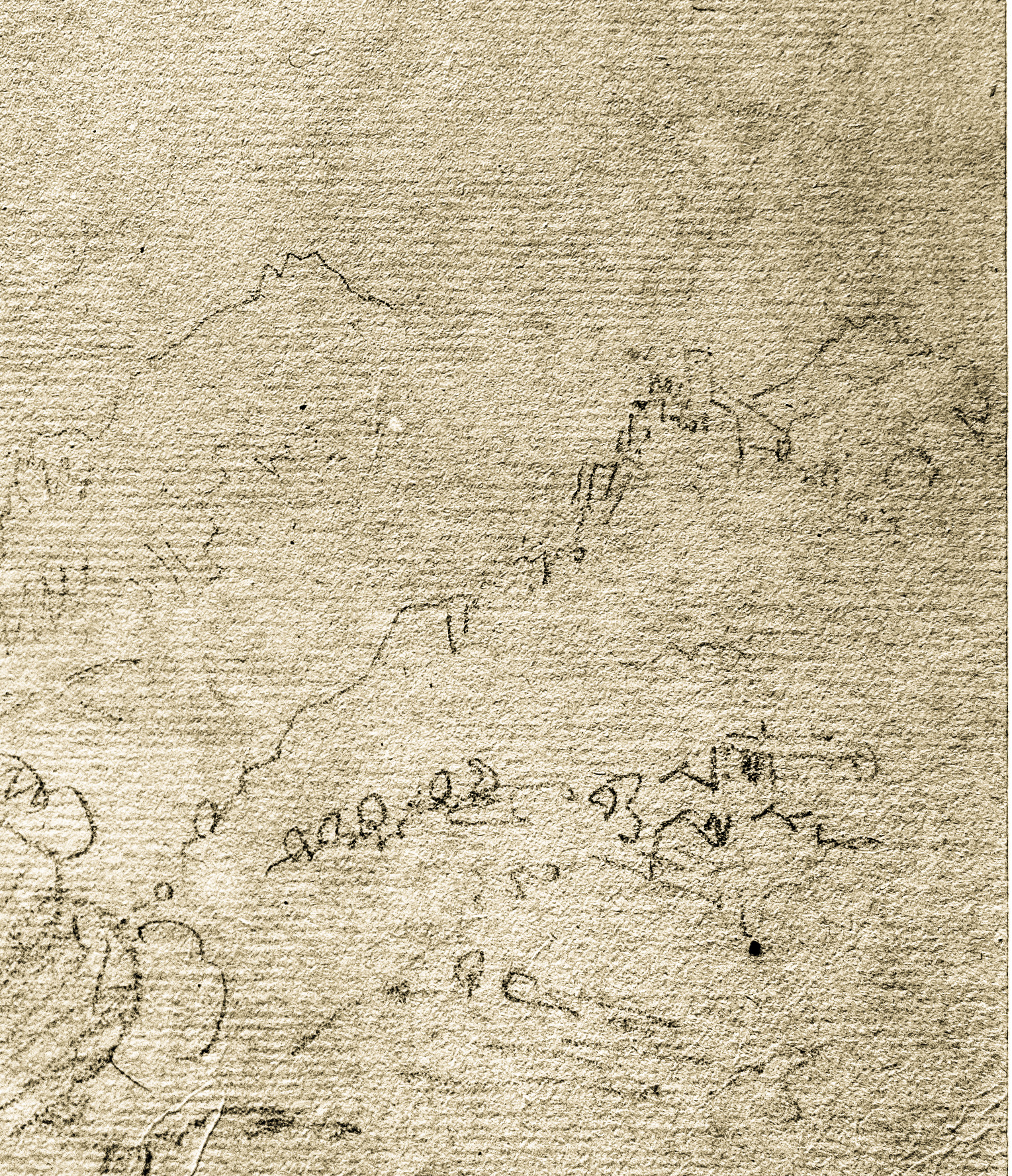
5 The right-hand part of Turner’ sketch Plate 1

6 Present-day view of the scene in Plate 5 (cropped from Plate 2)

7 The complete piece of paper that contains the most likely title for the sketch, in Turner’s own hand.
Lumby 20140916-4893 Public Domain
Plate 7 shows Turner’s most likely title for the sketch. It reads ‘Ville de Salle. Valley de Aoust. La Coté sud de Mt Blanc’. We are lucky to have probably all his own titles for the Grenoble Sketchbook’s 97 drawings, but we are unlucky in that all of them have become separated, so that we are left to assign these titles to drawings as best we can.
As we have identified the subjects of the sketch, the above would normally be the end of the story. However, we now introduce an oil painting (Pl 9). We will shortly recall the considerations of previous historians, but for now, a comparison with the above beckons.
In comparing the background mountains in this oil painting with those in Plates 5 and 6 we see a reasonably close match, other than for an extra peak to the left of the castle and behind the slope up to the Tête Drumianaz. If Turner was indeed using his sketch for reference, we recall that this part had been obscured by cloud but that, once in La Salle, this cloud may have cleared sufficiently to reveal that a previously hidden and impressively rugged peak had come into view (see Pl 8). Given the eye-catching nature of this previously hidden mountain, and the memorable intersection of the castle and the two slopes in the sketch, it seems a reasonable conjecture that Turner retained all this in his famously impressive visual memory – and included it in the oil painting.
 viewed from La Salle_©Lumby 20110923-g-6314-crop.jpg)
8 The rounded peak of the Tête Drumianaz - that is in Plate 6 - but now viewed from La Salle, revealing the rugged Testa di Liconi
Of equal importance are the many points of detail that match Turner’s castle in Plate 9 with a photo of the view today (Pl 10).

9 Mountain Scene with Castle, probably Martigny, c1802–3. Title in catalogue entry for Turner Bequest N00465.
Oil on canvas 43.8 x 54 cm. Here identified as a view of Château de Châtelard with an imaginary foreground.
Image Lumby in Germany 20191210-a-8690 Public Domain

10 Present-day view of Château Châtelard near La Salle in the Aosta Valley scaled for comparison with Plate 9.
© Lumby 20220223-36065+6
First, although the tower looks less tall in the painting, this is explained by two factors: a) that it was missing its top in Turner’s day; and b) a small part of a wall at the bottom of the tower having later fallen away, in the photo more of the tower is visible. Secondly, the match of the geometric arrangement of the walls to the left of the tower is remarkable. Note that this is carried through from the sketch. Thirdly, a close inspection of the walls to the right of the tower in Plates 9 and 10 also reveals matching items: the small piece of wall next to the tower, and even the oddly sloping wall that today terminates sharply. Fourthly, in today’s photo we see – from the area to the left of the wooden shed – a section of rock and wall that slopes down to the left below the ruined buildings, then descends more steeply. The same detail may be found in Turner’s painting.
Given the above, we are confident in asserting that the castle in Turner’s oil painting is Château Châtelard in the Aosta Valley, together with its mountain setting, and so should this be the title? When one compares the castle in the oil painting with the one seen from actually being on the ground, there seems little doubting that the subject is this particular castle. Indeed, the foreground in the painting is sufficiently dark to play only a minor role. Indeed, it was only when we had the chance to inspect the painting at an unusually well-lit exhibition in Germany that followed Tate cleaning and restoration that we became aware of the foreground detail. Our photo taken there (Pl 9) has been further brightened so that readers may find all the content. But in order to consider our re-titling of the painting, please go by viewing the actual painting, not simply by our enhanced image as this gives a misleading overall impression.
This enhanced image makes plain that the bottom half of the painting is most unlikely to belong to the setting, and it is this mismatch that, in our opinion, has caused doubts over the subject. Even this point could, however, to some extent be wrong, as so much of all mountain landscapes have changed due to water-management being needed to protect land and habitation from the devastating flows of water that used to cause such regular misery, and still occasionally do. One aspect has been to confine water to strongly constructed waterway channels that in some cases have diverted flows completely and removed or controlled cascades. Another is the disappearance of ponds from land which in Turner’s day supported animal grazing, but which today is entirely given over to agriculture. Another is the disappearance of the once sizable ‘ponds’ that were needed to ensure an adequate supply of water to drive the many wood-cutting, steel-making and flour-grinding mills. We may therefore be certain that Turner would have seen a great deal more water in the landscape than we do today, and this has to be borne in mind when viewing his sketches and paintings.
In inspecting the local landscape on foot, we were interested to spot a ruin in the centre of a small group of buildings in a dip in the ground not far from the viewpoint: at the end of a dead-end access road. We attempted without success to determine if this had once been a mill. If so, it would have required a millpond between the viewpoint and the castle. In this case, though, such water could not be positioned as near in height to the castle as we see it in the painting, because although there may have been water in the fields below the castle, its location would have been well below the vertical view of the painting.
Much further down, at the bottom of the Aosta Valley, Turner would have come across many places where the Dora Baltea river would have offered just such opportunities for fishing. And given Turner’s interest in fishing, he could easily have in any event drawn on his love of fishing to complete the painting. It therefore seems most unlikely that we may ever find a matching location for the lower part of the painting.

At this stage of our analysis, we believe it is safe to ascribe Château Châtelard as the subject of the painting, with a note mentioning that the foreground makes a convenient generalized artistic completion of the work, drawn from Turner’s interest in fishing. But we will add that we do not quite understand what the figure in the subject oil painting is actually doing. We have no expertise in angling, and so maybe an angler could study our detail (Pl 11) and explain how this odd-looking body position might arise.
11 Detail of painting in Pl 9, the angler
The contributions made by Tate Britain and previous historians to our understanding of the Turner oil painting (Pl 9) discussed above are now considered. In turning in the first place to the official information at Tate Britain, we note that the 2010 Display caption reads: ‘Once thought to be Wales, this view is now believed to be of Martigny.’ The official Catalogue entry is headed ‘145b N00465 Mountain Scene with Castle, probably Martigny c. 1802–3’ but the content is a re-worded version of an entry in the two-volume catalogue by Martin Butlin and Evelyn Joll, The Paintings of J.M.W. Turner (revised edition, New Haven and London 1984), and is even the source of the ‘145b’ in the title, as this is the reference to the image in their second volume. Sadly, no more updated version of this publication has been published.
Surprisingly, in spite of re-wording the reference entry, Tate Britain seems not to have updated the actual information. For instance, the last exhibition of the work is stated to have been at London’s Royal Academy in 1974–75, which is puzzling given that we viewed it in both Switzerland and Germany in 2019, and so one is left wondering if it may have been exhibited elsewhere between these dates. One also might be misled into thinking that the words ‘until recently’ mean what they say, whereas in fact they date back to the 1984 Butlin and Joll publication, i.e. to almost 40 years ago. Nevertheless, we press on to check the references, as these are Tate Britain’s justification for the current title.
The painting was among those many works found in Turner’s studio after his death in 1851, but we can find no record of his ever having titled the work or displaying it, so experts have had to attempt to determine its subject as best they could. The entry informs us that the painting was thought at first to belong to the series of early Turner works following his visits to Wales in 1798–99, yet the references fail to tie the painting to a sketch; nor is a possible sighting reported from on the ground. The uncertainty of the title during the second half of the 19th Century is exemplified by Walter Thornbury in his Life and Correspondence of J.M.W. Turner, where on page 418 of the 1877 edition he simply writes:
About 1800 he painted his Mountain Scene; with a castle on a hill in the middle distance, and a man angling in a stream in the foreground; taken perhaps in Wales.’
This was subsequently handed on from historian to historian and eventually taken up in the 1977 first edition of the Butlin and Joll catalogue where they write under Mountain Scene with Castle:
Related to the ‘Dinevor Castle’ sketchbook, especially those tentatively identified by Finberg [in the 1909 catalogue] as Caer Cennen.
But the problem here is that Caer Cennen is way larger than our subject castle and, in trawling through all Turner’s Welsh sketches, we could find nothing that architecturally matched the subject oil.
Turner’s Welsh works are nicely summarized in Andrew Wilton’s 1984 Turner exhibition catalogue where we now refer to Dolbadarn Castle, North Wales 1799–1800 (image page 27, and text, page 98). This painting relates stylistically to our subject oil, and Wilton writes:
Turner made numerous drawing of Dolbadarn Castle in the sketchbooks that he used in 1798 and 1799, but this painting can hardly be said to be based on any of them … [with] … elements brought together here with little reference to topographical detail.
This is a notable Turner painting because it was his Diploma Work presented on his election as RA in 1802 and therefore of considerable importance to him. The key point is that Turner tied the work to a Welsh historical event, as Wilton explains in detail on pages 28 and 29 of his catalogue. Compositional elements similar to those above crop up in many of Turner’s paintings: the reference to a story; the inventiveness of the topography; the transposition of the landscape. But one thing is consistently precise: his architectural drawing.
It seems reasonable to suppose that as Turner sketched the Mont Blanc and Aosta Valley scene and Château Châtelard that he recalled his Diploma piece that put him in mind of eventually painting the oil we are discussing, with an accurate ruined castle set in its memorable intersecting mountain background, but with an invented tranquil foreground scene to finalize an artistically alluring piece that in total recalled happy, quiet, relaxed and sunny fishing days, as well as an exciting journey through the Alps and recent history.
Before we proceed to finalize our analysis, we interject a fascinating puzzle that arises about the oil in Plate 9 that was reported in an on-line article in the UK’s Daily Mail by Antonia Paget on 21 September 2020:
Two secret portraits by Britain’s beloved artist J.M.W. Turner have been discovered hidden beneath one of his famous landscape paintings. Portraits were revealed through infrared reflectography and x-radiography tests. The portraits [are] thought to depict the artist’s mother and artist Thomas Girtin.
We recall two facts that may have had a bearing. Girtin was a close colleague of Turner and the pair had together completed many paintings when they were students under the direction of Dr Monro, the director of Bethlem Hospital mental asylum. Even before the ratification of the peace treaty with France mentioned at the beginning of this research paper, Girtin had slipped over to Paris, returning with an excitingly ambitions plan to paint a huge panorama landscape of that city. But sadly he died, and Turner attended the funeral shortly before leaving on the 1802 tour. Turner’s mother was confined to that same mental asylum in 1800 and died there in 1804. We will leave the reader to speculate as to what might have been in Turner’s mind in making these over-paintings. Nevertheless, one may be sure that whenever Turner saw the finished oil painting in question, he would surely have recalled that these portraits lay hidden beneath.
Our final task is to attempt to understand why Tate Britain titles the subject oil painting ‘Mountain Scene with Castle, probably Martigny’. The most important thing to be clear about is that we are certain that the oil painting is not of Martigny’s La Bâtiaz Castle. We have studied la Bâtiaz on many occasions and have more than 100 photographs from every angle, and it is even the subject of one of Prue Bishop’s Sculptural Watercolour® paintings [ https://pruart.com/work051.htm ]. Quite simply, no view of Martigny matches either the castle or the background of the painting in Plate 9. Nevertheless, we are obliged to return to our consideration of the Tate on-line Catalogue to attempt to understand why the subject was thought to probably be La Bâtiaz Castle at Martigny. We have already pointed to the stylistic similarities with Turner’s Dolbadarn Castle in Wales, noting that there is no strong visual link between Turner’s painting of that name with the actual place, and that the title of that work stands entirely on the basis of the historical story that Turner attached to it. But in the case of the oil painting here, Turner seems to have left us with no story, although one should keep looking – as previous researchers will have been looking for the wrong subject.
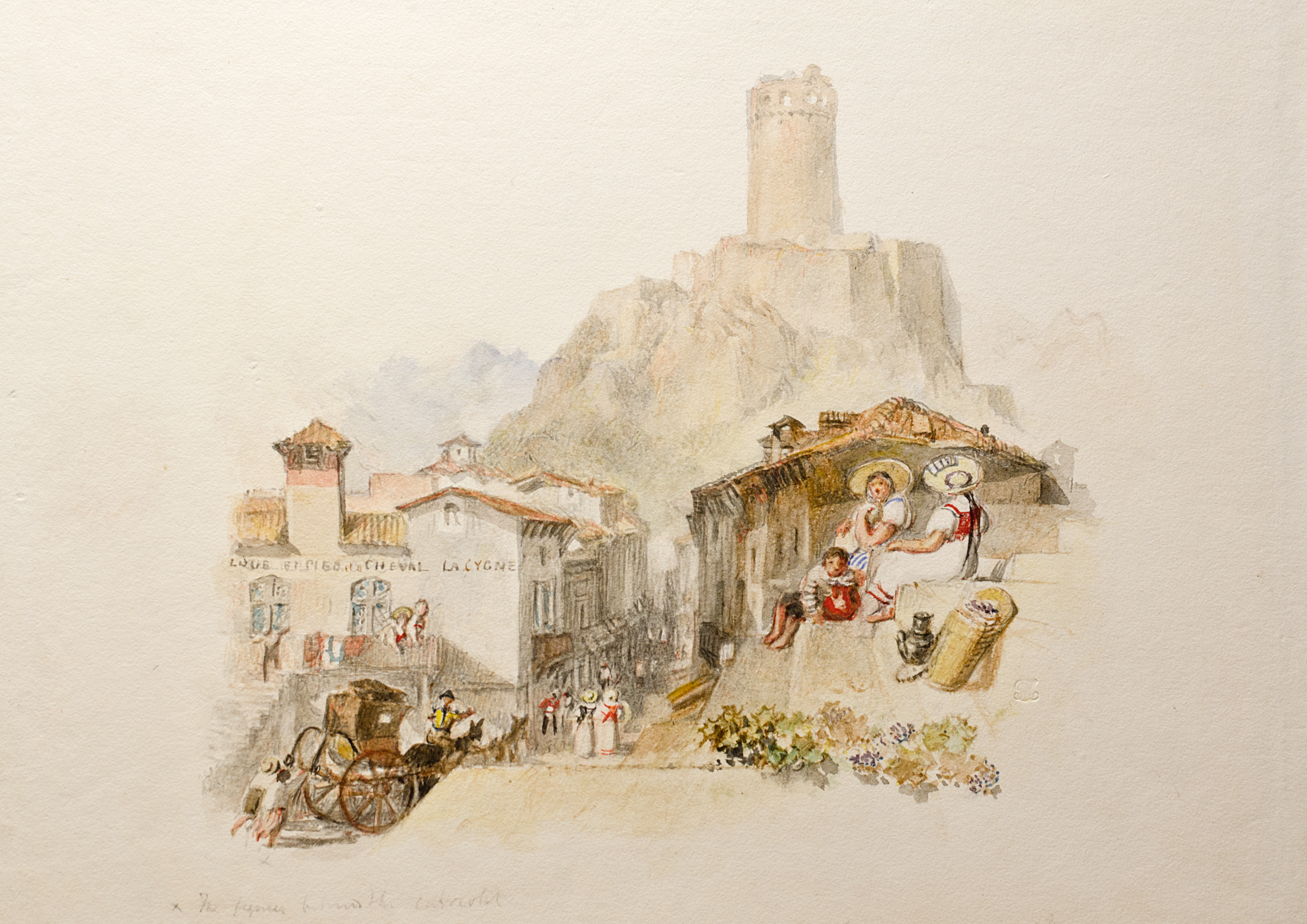
12 Martigny La Bâtiaz by JMW Turner, c1826–7, Tate reference D27671 TB-CCLXXX-154, for Rogers’s Italy.
Image Lumby 20120502-9098 Public Domain
The reason for adding ‘probably Martigny’ to the long- standing earlier title is explained by the Tate’s Turner Bequest on-line Catalogue as follows:
Andrew Wilton, comparing the castle [our Pl 9] to that in the watercolour of Martigny CCLXXX-154 [our Pl 12] is convinced that the painting shows la Bâtiaz at Martigny.
But when we compare the compositions in our Plate 12 and Plate 9, we strongly disagree, as there is nothing beyond perhaps the round nature of the tower that matches, and nor does the background or foreground, and indeed nor do any of Turner’s Martigny sketches. The Tate Catalogue entry for the subject oil painting also refers to the image of a coloured watercolour titled La Bâtiaz Martigny on page 72 of John Russell and Andrew Wilton’s book Turner in Switzerland published in Switzerland in 1976. But most oddly, the last paragraph of their text on page 73 makes plain it is not la Bâtiaz. This watercolour is part of the Turner Bequest with the Tate reference D17181 where the title remains in the Turner on-line catalogue as that published in the Finberg 1909 catalogue: ‘Castle in the Middle Distance c 1820’, with no reference to Russell and Wilton’s book, but with a suggestion dating back to Finberg that the subject may lie in Italy – with which we would strongly agree for several reasons, the most important being that it appears to have been painted at the same time as a watercolour titled The Temple of Vesta Tivoli TB-CXCVI-U that belongs to his first tour of Italy in 1819. But for our purposes, this reference too provides no basis for our Plate 9 being a view of Martigny’s La Bâtiaz.
For the first time, we have precisely identified a detailed pencil sketch that Turner made from near La Salle in the Aosta Valley in 1802 as being a view looking back towards the Mont Blanc Massif with the highest peaks hidden by cloud. The view includes the Château de Châtelard. We have also assigned to it Turner’s own most likely title. Concerning the Turner oil painting N00465, we could find no reliable references or evidence to support the present official title attaching the words ‘probably Martigny’. We have provided strong evidence that the subject and setting of the entire upper part of the oil painting N00465 relates to Turner’s 1802 sketch LXXIV 69 in his Grenoble Sketchbook Tate Ref D04562 and that the painting should be re-titled: ‘The Château de Châtelard in the Aosta Valley in its Alpine setting, to which Turner has added an imaginary angling scene’.
prue.bishop@artandpublishing.ch john.bishop@artandpublishing.ch
Return to the Turner Research index page
 |
 |
 |
This page was updated on February 10, 2025
115.png)
Art and Publishing GmbH of Switzerland CHE-209.693.835 All Rights Reserved
The Editor :
please email
Exhibitions - Loans - Purchases :
please email